




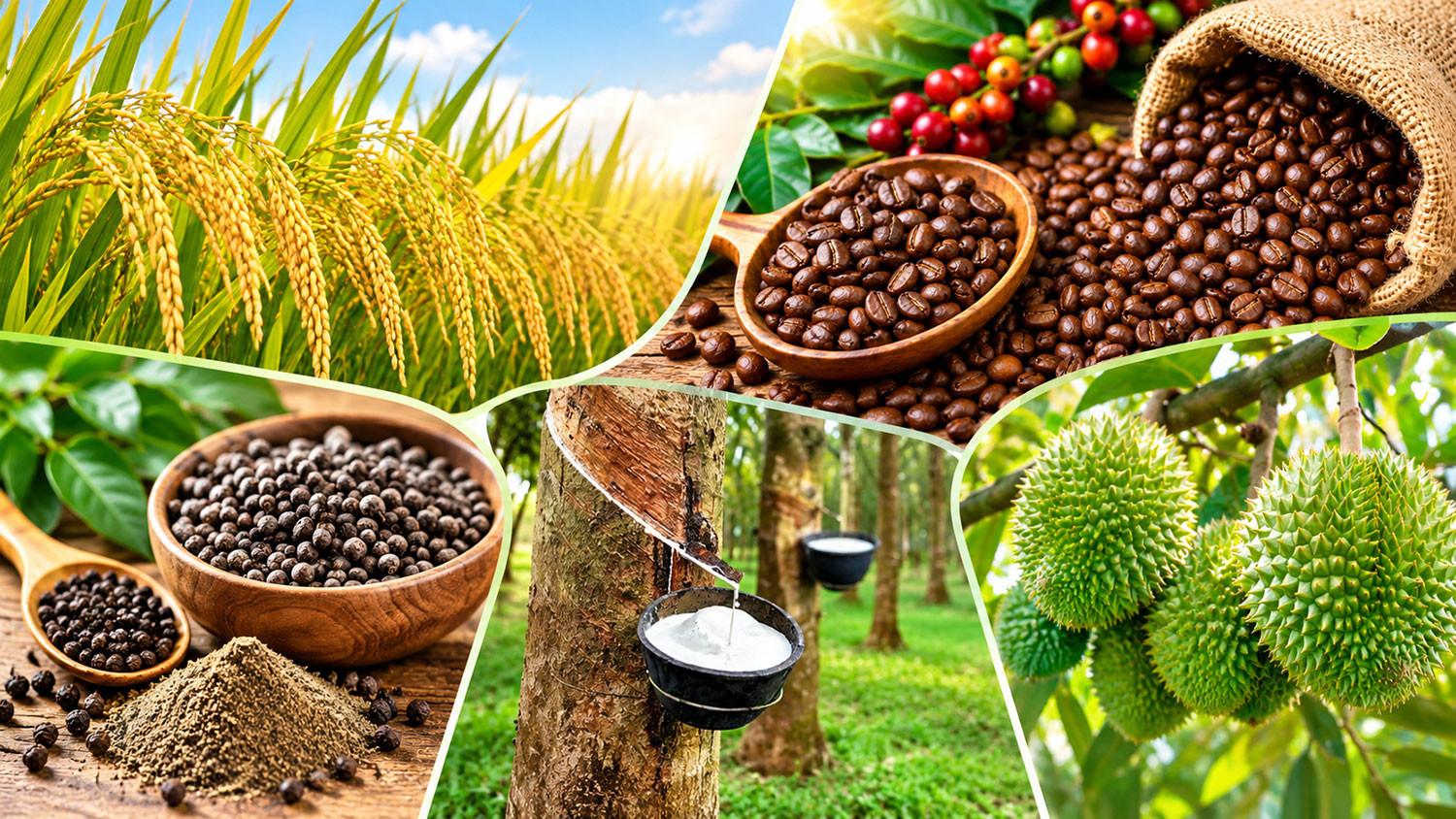
 By 2025, Vietnamese agricultural products were being exported to more than 180 countries and territories, highlighting the need not only to expand market access but also to identify which markets should be consolidated, which offer further growth opportunities, and which warrant a more cautious approach. A study by Tran Cong Thang, Nguyen Anh Phong, and Vu Huy Phuc proposes a method for classifying agricultural export markets using a weighted set of criteria and tests the method on three major export commodities: rice, fruits and vegetables, and coffee. The findings provide a systematic reference for developing market strategies tailored to the characteristics of individual commodities.
A multicriteria framework for export market assessment
The expansion in the scale and geographic reach of agricultural exports has been a defining feature of Viet Nam’s agricultural trade in recent years. The value of agricultural exports reached USD 62.6 billion in 2024, according to figures cited by the authors. Together with free trade agreements (FTAs) and export promotion programs, the expanding network of export destinations has created additional opportunities for businesses to meet consumer demand across different regions.
However, individual markets differ in import demand, competitiveness, tariffs, product standards, transportation costs, and stability. A market with a large import value is not necessarily the most favorable destination for every commodity. Conversely, a relatively small market may offer significant opportunities if demand is growing rapidly and Vietnamese products can meet its market access requirements.
In response to these conditions, Tran Cong Thang, Nguyen Anh Phong, and Vu Huy Phuc, from the Institute of Strategy and Policy on Agriculture and Environment (ISPAE), developed a method for classifying agricultural export markets using weighted multi-criteria scoring that combines quantitative data with expert assessments. The study aims to establish a tool applicable across different agricultural commodities, enabling government agencies and businesses to assess market priorities using a relatively consistent set of criteria.
The framework comprises 11 criteria grouped into four categories: market size, competitiveness, growth potential, and risk level. Market size carries a weight of 60%, competitiveness 26%, growth potential 5%, and risk level 9%. This allocation reflects the prominent role of market size and Viet Nam’s existing export position while also accounting for market access conditions, growth opportunities, and factors that may affect trade.
The assessment draws on data concerning export value and growth rates, Viet Nam’s market share, the size of importing markets, import tariffs, transport distances, and participation in free trade agreements. Factors that cannot be fully captured by quantitative data, such as technical requirements, sanitary and phytosanitary (SPS) measures, and market stability, are assessed through expert evaluation combined with relevant secondary information.
Aggregate scores are used to classify markets into five groups: key markets, potential markets, emerging markets, niche markets, and frontier markets. Each category represents a different position within an export market development strategy, providing a basis for selecting appropriate approaches and allocating resources accordingly.
An important feature of this method is that it does not rely solely on current export values but considers them in relation to other factors. This multidimensional assessment provides a more comprehensive picture of the position of each market for a particular commodity, rather than merely reflecting trade volumes at a given point in time.
Distinct market profiles across three commodities
To test the Nsuitability and practical applicability of the framework, the authors applied it to three of Viet Nam’s major export commodities: rice, fruits and vegetables, and coffee. These commodities have distinct market characteristics, allowing the classification method to be examined under different export conditions.
For rice, the Philippines, Indonesia, Malaysia, Ghana, and Côte d’Ivoire are classified as key markets. The Philippines, Indonesia, and Malaysia have long-standing trade relationships with Viet Nam in rice and account for substantial shares of Vietnamese rice exports. Their participation in ASEAN trade arrangements also facilitates trade between Viet Nam and these markets. Ghana and Côte d’Ivoire, meanwhile, demonstrate that geographic distance is not the sole determinant of a market’s position. According to the study, imports of Vietnamese rice by both countries have increased, and demand is substantial.
South Korea, China, and the United Arab Emirates (UAE) are identified as potential markets for rice. China is a particularly noteworthy case because its position in Viet Nam’s rice export structure has changed compared with earlier periods. According to the study, the share of Vietnamese rice exports destined for China has fallen to approximately 3–5% in recent years, while rice import demand in South Korea and the UAE has increased and remained relatively stable.
For fruits and vegetables, China, the United States, and Thailand are classified as key markets. China plays a particularly important role, accounting for approximately 65% of Viet Nam’s fruit and vegetable exports, according to the figures used in the study. Its geographic proximity, favorable trading conditions, and strong demand for several fruits in which Viet Nam has a competitive advantage help explain this position. The United States also ranks as a key market despite the greater transportation distance, indicating that market access and the ability to expand market share are not determined by geographic proximity alone.
South Korea, Australia, and India are classified as potential markets for Vietnamese fruits and vegetables. This finding suggests that, alongside maintaining established markets with substantial trade volumes, the sector should also consider markets where import demand is developing or expanding and assess the specific conditions needed to increase the presence of Vietnamese products.
For coffee, the key markets are Germany, Italy, Spain, Japan, the United States, and the Netherlands. These markets have long-standing trade relationships with Viet Nam in coffee and account for significant shares of the country’s coffee exports. The presence of several EU member states among the key markets also highlights the importance of trade conditions under the EU–Viet Nam Free Trade Agreement (EVFTA).
Meanwhile, Russia, the Philippines, China, Malaysia, South Korea, and Indonesia are classified as potential markets for coffee, while Thailand and Greece are identified as emerging markets. These findings indicate that development opportunities are not confined to traditional coffee-importing markets but may also exist in countries where consumer demand is increasing.
These examples illustrate the method’s ability to distinguish established key markets from destinations with further growth potential. However, the classifications reflect conditions at the time of the study rather than fixed rankings. A market’s position may change as import demand, market share, market access conditions, and other relevant factors evolve.
Why the same market calls for different commodity strategies
One of the study’s most practically significant findings is that the same country may fall into different market categories depending on the agricultural commodity concerned. China illustrates this clearly: it is classified as a key market for fruits and vegetables but as a potential market for rice and coffee in the study’s results.
These differences reflect the specific characteristics of each commodity, including import market size, the position of Vietnamese products, competitive conditions, logistics, and applicable standards. A market may have strong demand for one product without holding an equivalent position for another. Consequently, relying solely on the overall size of a market or a country’s general position in agricultural trade may not provide government agencies and businesses with a sufficiently accurate assessment of priorities for individual commodities.
The authors’ approach evaluates market selection in relation to both Viet Nam’s supply capacity and conditions in the importing country. For key markets, businesses should focus on maintaining market share, securing a stable supply, improving product quality, and meeting applicable standards. For rice, these priorities are linked to reliable supply and long-term contracts. For fruits and vegetables, SPS requirements and logistics are particularly important, while greater value addition through processing and brand development are identified as strategic directions for coffee.
In potential markets, export expansion should be accompanied by research into consumer demand, competitors, and distribution systems. Businesses can make use of FTA preferences while identifying technical or quarantine-related barriers that need to be addressed to improve market access.
For emerging markets, an appropriate approach is to explore demand, identify suitable partners, and gradually establish distribution channels before expanding operations. Niche markets, meanwhile, may be suitable for specialized, high-quality, or higher-value-added products. In frontier markets, businesses need to carefully assess import market size, trade costs, and risks before committing substantial resources.
The value of the classification system therefore lies not only in identifying priority markets but also in suggesting differentiated approaches based on the characteristics of each market category. This enables market strategies to be aligned more closely with product characteristics and actual trading conditions.
Implications for trade policy and business decisions
For government agencies, the market classification method can serve as a reference for setting trade promotion priorities, determining where market information should be provided, and developing business support activities. Identifying promising markets by commodity can help tailor trade-matching initiatives, market-opening efforts, and updates on import requirements more closely to practical needs.
For businesses, the classifications provide a more structured basis for selecting target markets and allocating resources. Maintaining a position in key markets requires attention to product quality, supply reliability, and compliance with standards. Developing potential markets calls for demand analysis and stronger competitiveness, while entering emerging markets requires a phased approach proportionate to market size and the degree of uncertainty surrounding the opportunity. This framework can help businesses make more informed decisions about balancing existing market share, market expansion, and export risk management.
Nevertheless, the effectiveness of the tool depends on the regular updating of commodity-specific databases. Changes in export value, market share, tariffs, trade agreements, SPS requirements, logistics, and market stability can all affect assessment results. The authors also recommend further refining the weighting system, updating the criteria, and extending the method to additional agricultural commodities.
The application of the method to rice, fruits and vegetables, and coffee indicates that it can identify market priorities and distinguish relevant market characteristics across commodities. However, the tool is not a substitute for in-depth market research or the specific assessments businesses must undertake before making commercial decisions. Its value lies in providing a systematic reference framework that supports market selection based on multiple factors rather than relying primarily on current export values.
As international agricultural markets continue to evolve, classifying export markets by commodity offers a useful approach to policy formulation and export planning. When supported by appropriate, up-to-date data and linked to businesses’ operating conditions, the method can help clarify market priorities, improve resource allocation, and strengthen the capacity of Viet Nam’s agricultural exporters to respond proactively to changing market conditions.
Sources: This article is based on the study “Classification of Viet Nam’s agricultural export markets: Method and application” by Tran Cong Thang, Nguyen Anh Phong, Vu Huy Phuc, published in the Science Journal of Agriculture and Environment, Issue 1, August 2026.

A survey of 90 whiteleg shrimp (Litopenaeus vannamei) farming households in the Mekong Delta found that probiotics are widely used in intensive and super-intensive production systems, whereas prebiotics and synbiotics remain less widely adopted. The findings provide practical evidence to inform the development of biological solutions better suited to production conditions, helping improve pond management and support more sustainable shrimp farming.

Research into plant-derived crop protection products is opening new avenues for sustainable agriculture. A study by Nguyen Van Phuoc, Ho Truong Huynh Thi Bach Phuong, Huynh Ba Di, and Cao Khoi Nghia of Kien Giang University found that nanoemulsions formulated from pond apple (Annona glabra) and lemongrass (Cymbopogon citratus) leaf extracts inhibited the fungal pathogen that causes rice blast and the bacterium responsible for bacterial leaf blight under laboratory conditions. These preliminary findings provide a scientific basis for further research into plant-derived formulations aimed at managing rice diseases while reducing reliance on synthetic chemical pesticides.

Effective implementation of the 2023 Law on Cooperatives requires not only dissemination of its provisions but also practical guidance and support mechanisms tailored to cooperatives’ operating conditions. A 2025 field survey conducted by Phung Giang Hai, Hoang Minh Huy, Vu Thi Thu Giang, and Nguyen Thi My across six localities identified challenges in applying six groups of new provisions and assessed support needs relating to legal compliance, governance, financial management, and operational arrangements. The findings provide an empirical basis for refining implementation guidance and developing support measures that better address the needs of agricultural cooperatives in Viet Nam.

A laboratory-scale study by Nguyen Thi Minh, Do Thi Thuy, and Le Minh Nguyet of Vietnam National University of Agriculture (VNUA) found that combining selected bacterial strains with microalgae improved domestic wastewater treatment efficiency. After 14 days, the combined system achieved a chemical oxygen demand (COD) removal efficiency of 96.67%, while substantially reducing organic pollutants, nutrients, and microbial indicators of contamination.
A study by Khong Ngan Giang and colleagues investigated genetic variation in three promising rice mutant lines using whole-genome sequencing data. By analyzing 186 genes associated with growth, yield, and grain quality, the researchers identified 10,614 single-nucleotide polymorphism (SNP) and insertion/deletion (INDEL) variants and designed 42 candidate INDEL primer pairs. The findings expand the available genetic variation data and provide potential tools for genetic research, germplasm evaluation, and marker-assisted rice breeding.