




 In Xích Lô’s Notebook, Lê Minh Hoan writes less as a policymaker than as a listener to the quiet rhythms of rural life. This piece lingers in the countryside—where memory is not something left behind, but something still being lived, in gestures, in people, in the texture of everyday life. From an old woman weaving bamboo baskets to the changing paths of a younger generation, the story draws us toward a simple yet enduring truth: keeping the village is not an act of nostalgia, but a way of holding on to the roots from which the future must grow.
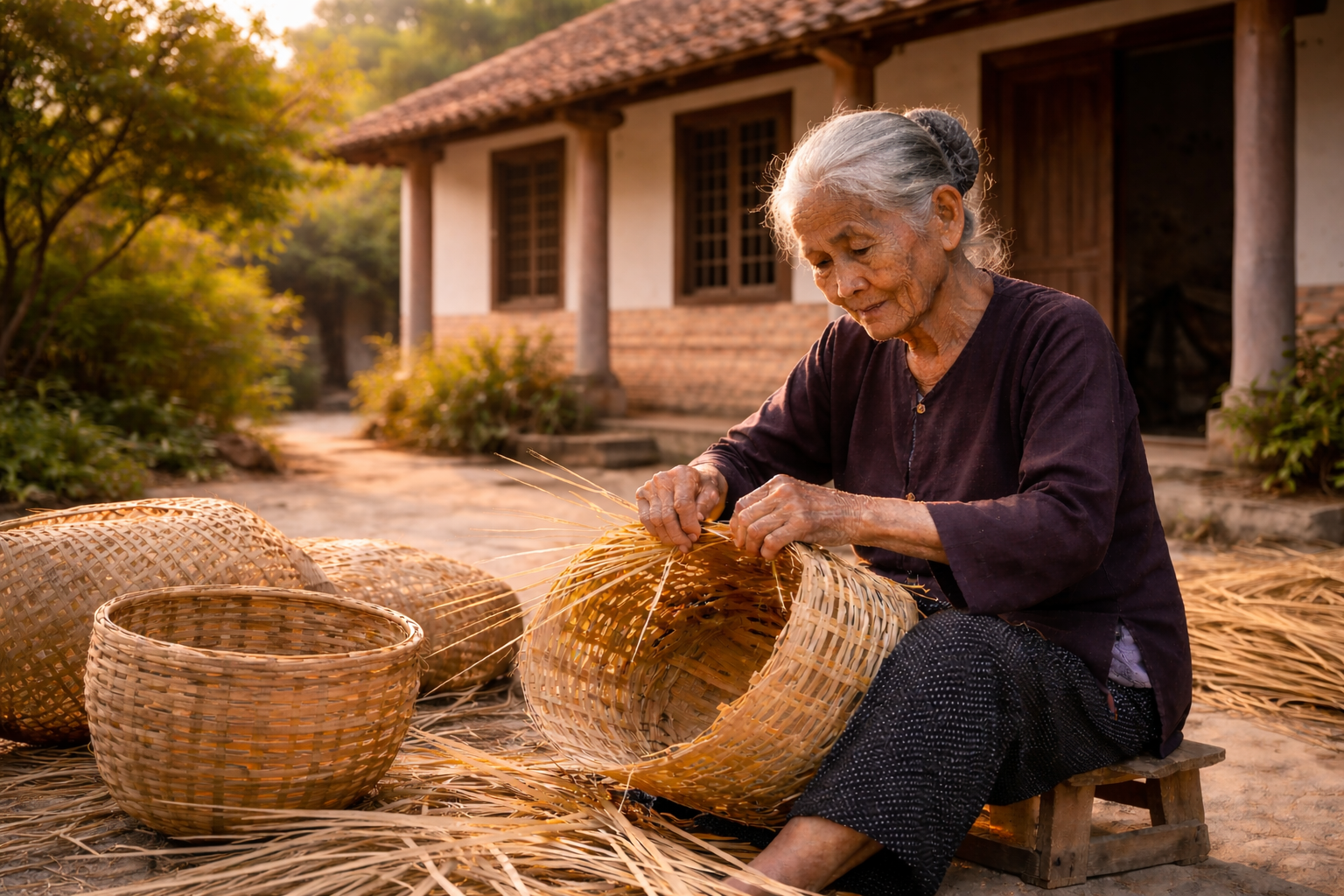
THE COUNTRYSIDE, WHERE HERITAGE STILL LIVES |
One morning in the final month of the lunar year, dew still lingered on the tips of the rice, and the villagers were already in the fields. Along the Tiền River, the plain revealed itself in a chill so light, so delicately held. A breeze moved past hibiscus hedges, slipped through rows of aging bamboo, carrying with it the scent of kitchen smoke and the soft calls of vendors selling rustic cakes at the edge of the hamlet.
An old woman sat by the veranda of her tiled house, her hands weaving a bamboo basket as they had for decades. Unhurried. Sparing in words. Someone asked, “You still weave?”
Her hands did not pause. “As long as I can see, as long as I have my hands, as long as there is bamboo to split—I will keep weaving. This craft won’t make you rich, but it keeps you whole. Keeps the village whole. It holds onto something the young often forget now—memory.”
Some say the countryside is a place for remembering. But memory, if not kept, will fade. Others say heritage belongs to the past. But if the past is left to rest undisturbed, the present slips away—like water through open fingers.
Every village, in time, sees its people leave. But that does not mean the village disappears. It endures—in each traditional cake, in the lullabies a mother hums, in the communal house whose paint has weathered, but whose meaning has not.
Once, a young man said, “It’s hard to make a living in the countryside now. No one keeps the old trades. The young have all gone.” And yet, after a visit home, he began a YouTube channel to tell stories of his village—of the stone mill grinding flour, of the well that stays cool through every season, of the market that gathers only on the morning of the full moon.
And he called it an inheritance of memory.
Rural heritage does not live in museums.
It lives in people—in quiet acts of kindness, in the unadorned grace of moss-covered roofs, in the instinct to think first of the community.
The deeper we move into the digital age, the more clearly we see: some values cannot be replaced by technology.
The voice of one’s homeland cannot be translated.
A mother’s homemade cake cannot be placed on an e-commerce shelf.
And the almond tree at the village gate—where generations of students carved their names—cannot be preserved in pixels.
Many countries have understood this.
In Japan, old villages have become among the most cherished destinations—not because they are new, but because what is old has been carefully kept. Every roof, every fence, every step holds a living story. People do not leave, because the village provides livelihoods, preserves identity, and offers a quiet sense of pride—a place where life continues alongside homestays, local specialties, and the passing on of traditional crafts. The government does not take the place of the people, but supports them—with legal frameworks, with the preservation of materials, and with thoughtful, balanced planning.
In South Korea, children learn to cook traditional dishes, to make handmade paper, and to practice calligraphy—not to become artisans, but to understand where they come from. Nothing elaborate is required. Only a life lived close to memory. Heritage is woven into education, forming ecosystems of learning across generations. It is not frozen in museums; it becomes classrooms, workshops, and spaces for creativity—alive, and still unfolding.
In countries where architectural heritage has been carefully preserved, each village is treated as a brand—a place to live, and to tell stories. Local products, festivals, and cuisine become economic assets, yet the soul of the village remains intact. Each village carries its own identity, its own visual language, its own presence across national platforms. Villages do not merely endure—they carry their identity outward, into the world.
And what about us?
In the Mekong Delta, there are villages that still keep the craft of coconut-leaf cakes.
In Central Vietnam, some villages still perform bài chòi during festivals.
In the North, there are villages where scholars still write calligraphy for students before their exams.
But there are also places where wells have been filled in, village gates torn down, festivals replaced by commercial events.
There are places where children no longer know the names of village trees, cannot tell one rice season from another, no longer hear their mothers tell stories of those who came before.
To preserve heritage is not to cling to the past.
To preserve heritage is to grow with identity.
To keep the village is not to preserve what is old.
To keep the village is to shape the future from its roots.
A green rice field. A fish pond at the village edge. A folk song breaking its rhythm—these may well become answers for community-based tourism, for OCOP, for ecological agriculture, for a cultural economy that increasingly demands a clear sense of identity.
And so—
Let the elders tell stories of the homeland, and the young carry those stories onto digital platforms.
Let old crafts find new life—in heritage classes, in community spaces, in products that carry stories.
Let each village hold a “passport of memory,” a map of living heritage, and people who understand: we do not simply live on the land—we live within layers of earth shaped by generations before us.
If someone asks, “Where does rural development begin?”
Perhaps the answer is simple: it begins with keeping the village.
There is no sustainable future if the present turns away from memory.
There is no national identity if the countryside fades into obscurity.
To keep the village is to keep ourselves.
To preserve heritage is to keep the flame that lights the road ahead.
And one day, when future generations return, they will not need a map, nor search for the village name online. The scent of kitchen smoke, the midday crow of a rooster—these will be enough to know they have found their way home.

In modern life, sometimes a single familiar flavor is enough to carry us back into the quiet depths of memory. In “Xích Lô’s Notebook”, Lê Minh Hoan writes with a gentle, unadorned voice—leading readers through familiar scenes of the countryside before settling on a simple truth: development does not mean losing one’s roots. This small story invites us to pause, and to reflect more deeply on rural life, culture, and the enduring journey of preserving Vietnamese identity.
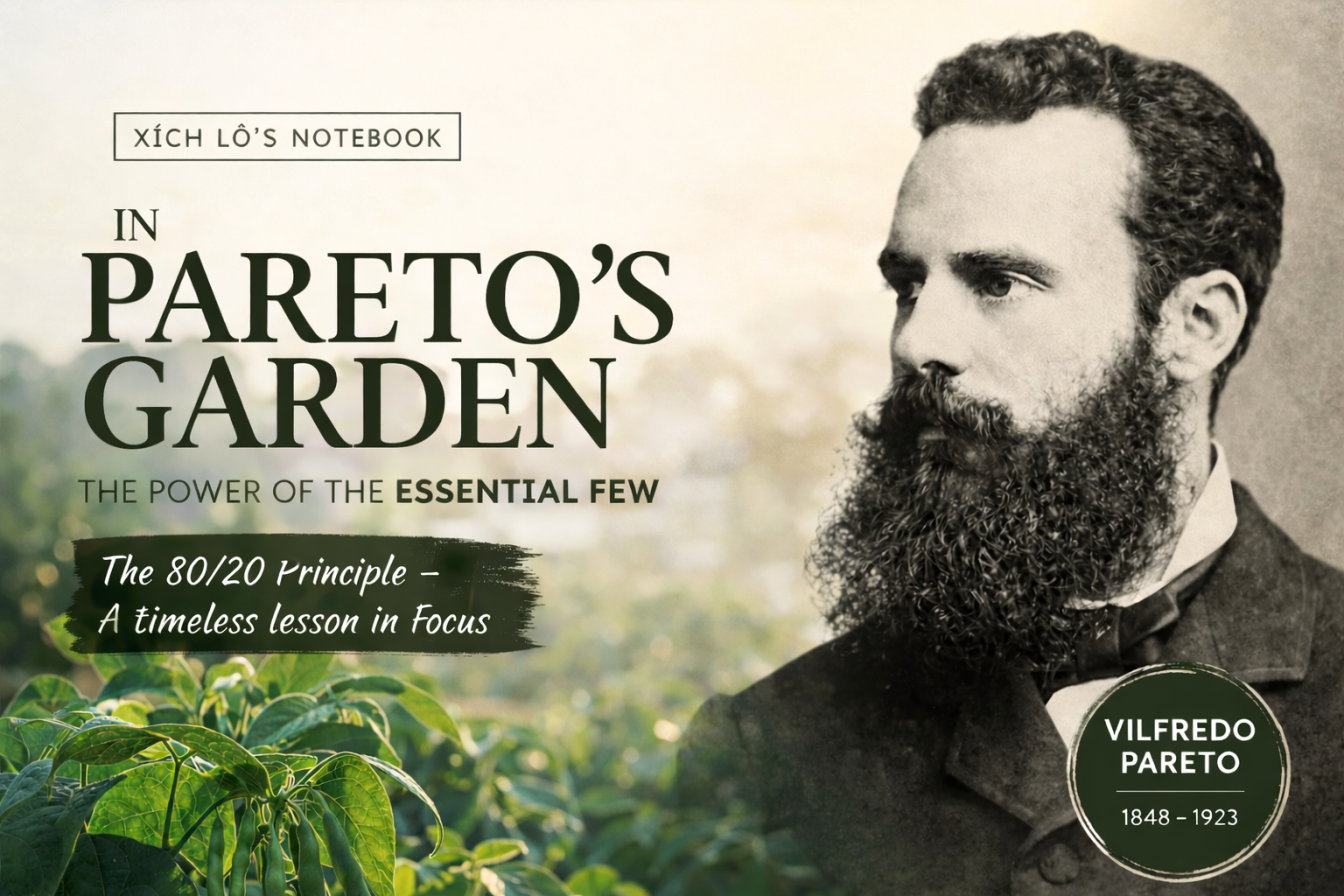
In his reflective “Xích Lô’s Notebook” series, Lê Minh Hoan revisits the story of Vilfredo Pareto—told through the simple image of a bean garden—to illuminate a profound insight. More than a statistical rule, the 80/20 principle emerges as a way of seeing: a reminder to look beyond the noise of abundance, to recognize what truly matters, and to act with clarity and intention.

In "Xích Lô’s Notebook" by Lê Minh Hoan, even the smallest moment—a rice seedling leaning in the wind—can open into something deeper. From there, nature quietly offers its lessons on how to live, if we are willing to pause and listen.
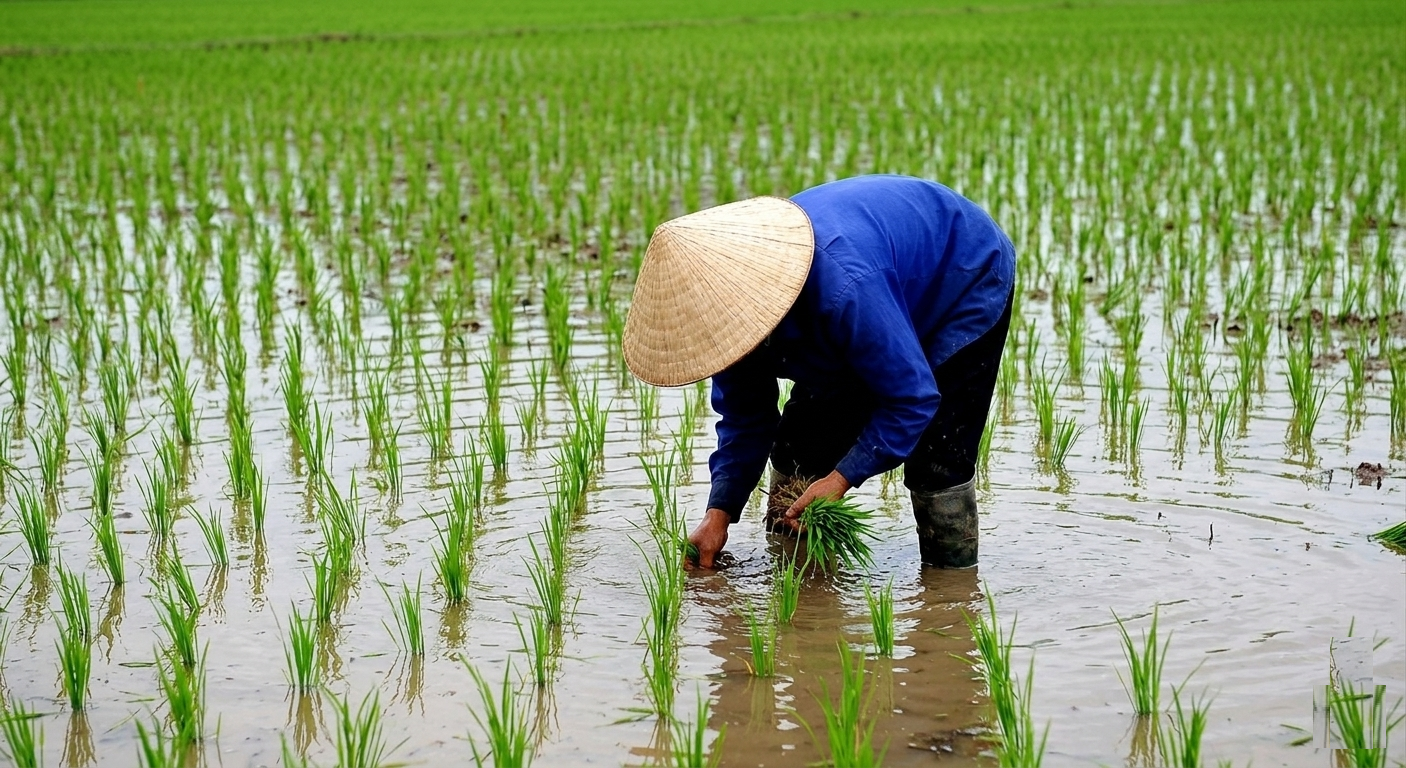
A quietly evocative fable by Lê Minh Hoan, featured in the “Xích Lô’s Notebook” series, draws from the familiar image of Viet Nam’s rice fields to illuminate a deeper philosophy of leadership and human conduct. Through the bending rice—heavy with grain—the author reflects on humility, attentive listening, and growth through lived experience, offering a gentle yet enduring lesson for those in public service and beyond.
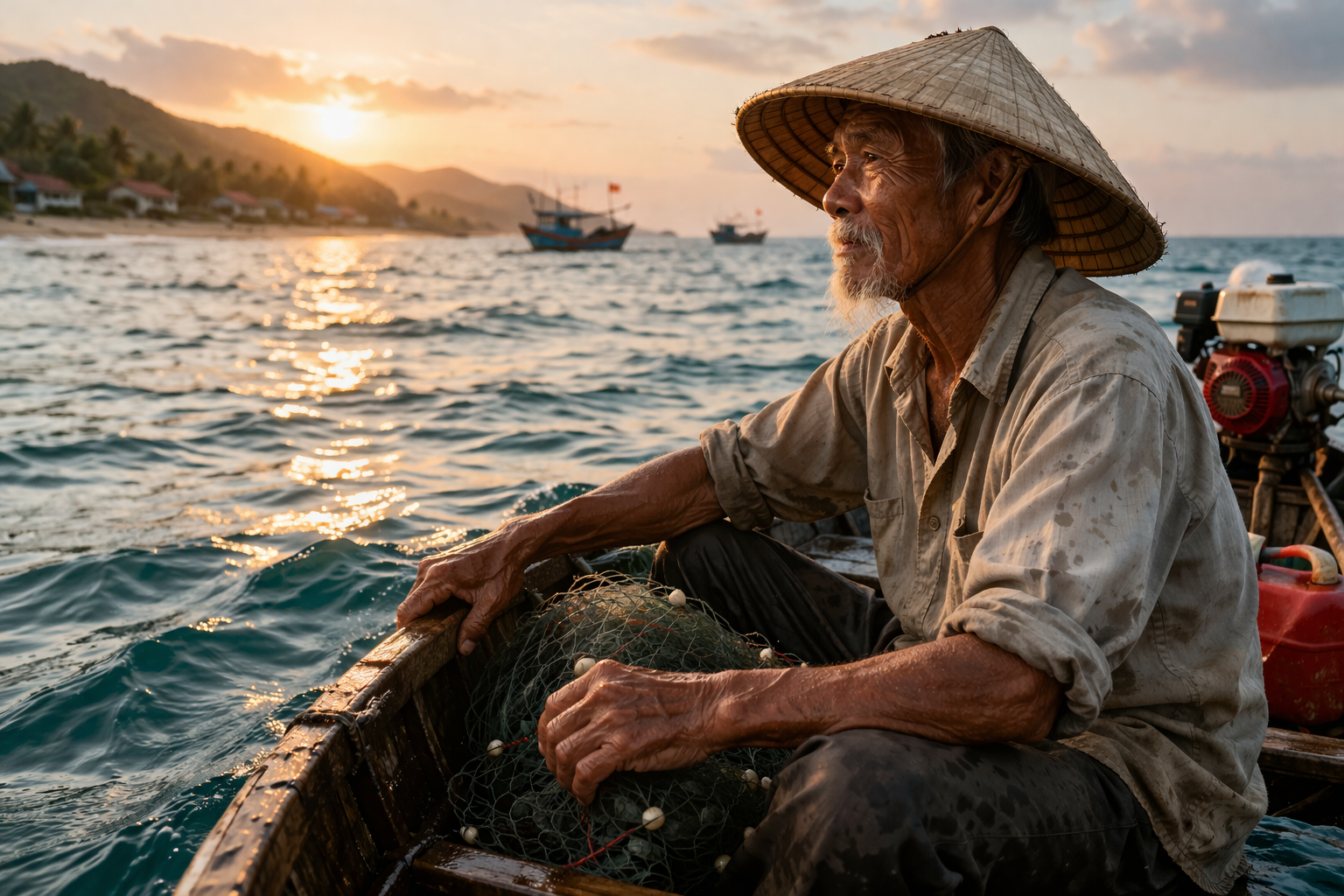
Some stories begin not with action, but with a quiet sense of loss. This is one of them. “The fisherman and the reef,” a short fable by Lê Minh Hoan in the Xích Lô’s Notebook series, reflects on the fragile bond between people and nature—reminding us that what sustains life is often what we are most at risk of forgetting.