


 Prof. Dr. Tran Hong Thai, President of the Viet Nam Academy of Science and Technology (VAST), was elected a Fellow of the International Association of Academies of Sciences (IAAS) during a plenary session of the association’s 39th Council session in Xi’an, China, on Oct. 26, 2026.
The session, held under the theme “Expanding scientific and technical cooperation among academies in the current context,” focused on strengthening cooperation among academies, universities and research organizations. The basic research strengths of academies can complement the training and technology development capabilities of universities and research institutions, creating opportunities for joint research initiatives and the training of future scientists.
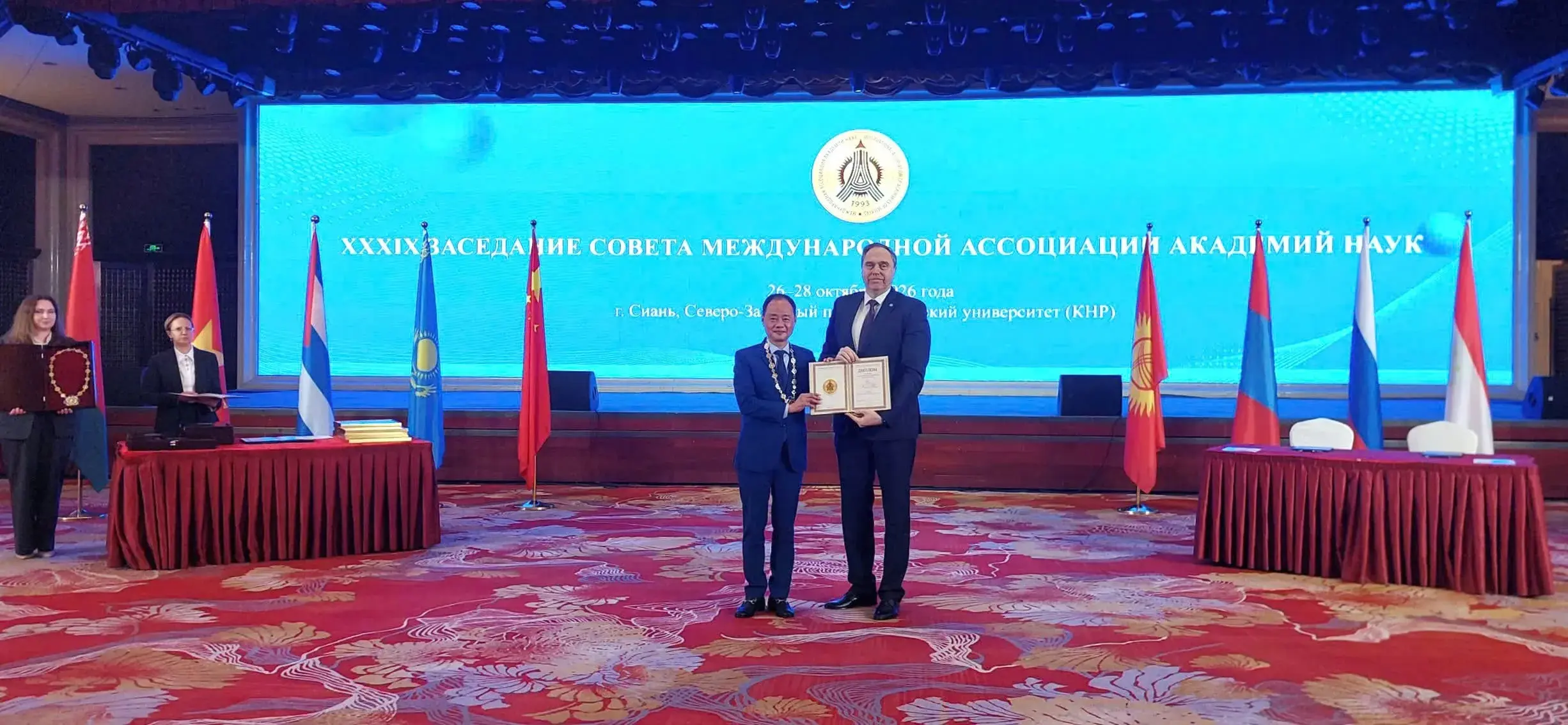
Prof. Dr. Tran Hong Thai was elected a fellow of the International Association of Academies of Sciences (IAAS) during the association’s 39th Council session in Xi’an, China, on October 26, 2026.
Prof. Dr.Tran Hong Thai’s election reflects recognition from the international scientific community and creates further opportunities for him to contribute to the association’s activities and strengthen international research cooperation.
Prof. Dr. Tran Hong Thai earned a university degree in automation and process control for thermal energy systems in Russia and a doctorate in Earth sciences and mathematics from Heidelberg University in Germany. His career has spanned hydrometeorology, science and technology management, and local development. His experience in education, research and administration has shaped his approach to scientific issues in relation to development needs.
As VAST president, Prof. Dr. Tran Hong Thai has promoted international cooperation to strengthen Viet Nam’s scientific and technological capabilities. He has outlined four closely connected priorities: sending Vietnamese researchers to institutions where new knowledge is being developed; encouraging Vietnamese scientists to participate in and contribute to international professional organizations; attracting international experts to conduct research in Viet Nam; and hosting international scientific activities.
The overarching goal is to enable Vietnamese scientists to participate directly in identifying research questions, designing programs, conducting studies and developing research outcomes with international partners. The knowledge and experience gained through these collaborations can help domestic research teams pursue new lines of inquiry, address emerging challenges and train the next generation of specialists.
This approach aligns with the cooperation opportunities IAAS is seeking to expand. The scientific strengths of academies, combined with the capabilities of universities and technology research organizations, can facilitate interdisciplinary research teams, shared scientific infrastructure and closer integration of training and research.
At the 39th session of the IAAS Council, VAST proposed establishing joint research groups, connecting scientific infrastructure, facilitating scholar exchanges, cooperating in postgraduate training and jointly developing intellectual property. The proposals aim to establish programs with clearly defined activities and outcomes, with each participating institution contributing to the work and strengthening its own capabilities.
Young scientists play an important role in sustaining long-term research partnerships. Participation in expert committees, research groups and international programs allows them to gain experience with new methodologies, build professional networks and contribute to collaborative scientific work.
For Prof. Dr. Tran Hong Thai, election as an IAAS Fellow represents recognition by the international scientific community and creates further opportunities to strengthen international research ties. For VAST, the benefits of international cooperation will be built through research, training and professional exchanges, helping develop scientific teams and strengthen Viet Nam’s research capacity.