



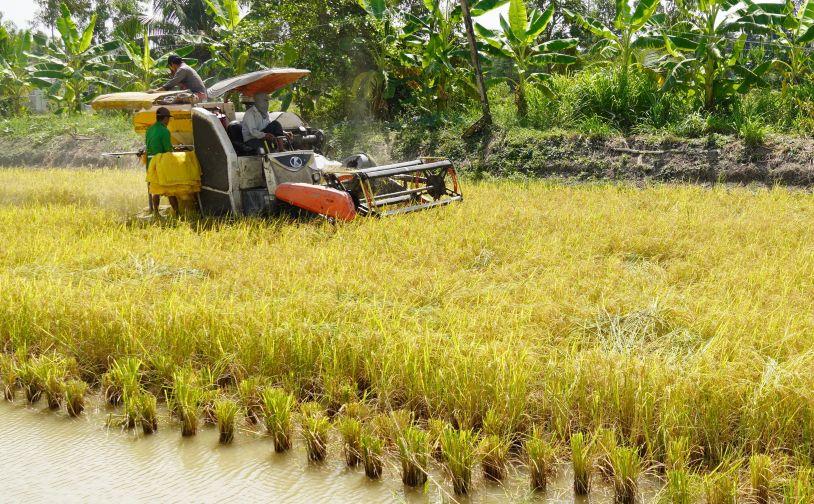
 Following episodes of drought and saltwater intrusion that required restructuring agricultural production in coastal areas, rice–shrimp and shrimp monoculture systems were adopted as adaptive strategies. However, changes in farming practices are accompanied by shifts in agroecosystem structure.
A study conducted by researchers from the College of Environment and Natural Resources, Can Tho University, in Hoa Tu and Ngoc To communes, Can Tho City, recorded 83 higher plant (macrophyte) species belonging to 39 families. The findings indicate that the rice–shrimp system maintains higher biodiversity levels than the shrimp monoculture system, based on quantitative ecological indices.
Agricultural restructuring and agroecosystem dynamics in coastal areas
Drought and saltwater intrusion during the 2015–2016 dry season significantly affected agricultural production in coastal areas of Can Tho City. In the winter–spring rice crop alone, 1,700.92 hectares were damaged. In response to increasing environmental pressures, households in Hoa Tu and Ngoc To communes gradually adjusted their production systems, transitioning to rice–shrimp or shrimp monoculture systems.
This transition is commonly evaluated in terms of livelihood outcomes and economic performance. However, changes in farming systems also generate measurable effects on agroecosystems, including higher plant communities, which play a fundamental role in community structure and ecological stability within cultivated landscapes.
The study was conducted from November 2023 to July 2024 to assess higher plant biodiversity in the two production systems operating in parallel in the study area. Rather than limiting the analysis to species composition, the research team quantified biodiversity using ecological indices to clarify differences in plant community structure between the rice–shrimp and shrimp monoculture systems.
Species composition: 83 higher plant species across two production systems
The survey recorded a total of 83 higher plant species belonging to 39 families. Angiosperms predominated, accounting for 37 families (94.87%) and 81 species (97.59%), while ferns comprised 2 species (2.41%).
Disaggregation by production system revealed clear differences. The rice–shrimp system recorded 68 species, compared with 57 species in the shrimp monoculture system. Forty-two species were present in both systems; 26 species were recorded exclusively in the rice–shrimp system, and 15 species occurred only in the shrimp monoculture system.
In both systems, Poaceae was the dominant family. However, the higher total number of species and the greater number of system-specific species in the rice–shrimp system indicate greater floristic richness compared with shrimp monoculture. These findings provided the empirical basis for further analysis of biodiversity structure using quantitative indices.
Biodiversity indices and differences in plant community structure
Analysis of biodiversity indices demonstrated a consistent pattern of differentiation between the two systems. The mean Shannon–Wiener diversity index (H') in the rice–shrimp system was 2.50, compared with 2.27 in the shrimp monoculture system. The mean Pielou’s evenness index (E) was 0.63 in the rice–shrimp system and 0.59 in the shrimp monoculture system. Simpson’s diversity index (D) was 0.86 and 0.84, respectively. Conversely, the mean dominance index (Cd) was 0.15 in the rice–shrimp system, lower than 0.17 in the shrimp monoculture system.
The Sorensen similarity index (SI) between the two systems was 67.20%, indicating a relatively high degree of similarity in species composition. Nevertheless, differences in diversity and evenness indices indicate that plant communities in the rice–shrimp system exhibit higher biodiversity and are less dominated by a limited number of species.
These findings show that under comparable coastal ecological conditions, different production systems can generate distinct plant community structures. In the rice–shrimp system, rotational cultivation between rice and shrimp creates cyclical environmental variation, supporting the persistence of multiple species groups within the cultivated landscape. In contrast, the shrimp monoculture system tends to exhibit a more structurally concentrated plant community.
Based on findings from the November 2023–July 2024 survey, the study proposes several measures to support biodiversity maintenance in agricultural systems, including strengthening farmers’ knowledge of biodiversity; limiting indiscriminate pesticide application; retaining 0.5–1.0 meters of natural vegetated field margins; and applying flexible crop rotation and diversification practices.
The findings also provide a scientific basis for biodiversity monitoring in farming systems adapted to saltwater intrusion, highlighting the relationship between vegetation management practices and plant community structure observed in the survey.
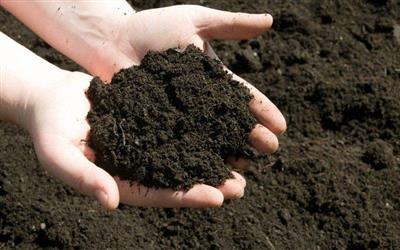
From what is often considered a valueless by-product, sludge generated from seafood processing plants and shrimp ponds, a research team comprising Nguyen Thi Bach Kim, Le Hoang Viet, and Nguyen Vo Chau Ngan (Can Tho University) has demonstrated its potential as a feedstock for organic fertilizer production. Analytical results indicate that seafood processing sludge (SPS) possesses more favorable characteristics for composting compared to shrimp pond sludge (ShPS), thereby opening new opportunities for circular agriculture.
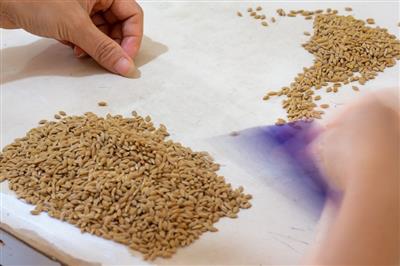
The research team from the Plant Resources Center (National Plant Gene Bank), comprising Le Thi Loan, Pham Hung Cuong, Doi Hong Hanh, Duong Thi Hanh, Nguyen Thi Hoa, Nguyen Thi Thuy Hang, and Nguyen Thi Bich Thuy, has recently reported a five-year (2020-2024) overview of ex-situ conservation of plant genetic resources in Vietnam. By the end of 2024, the system held 28,790 seed samples representing 125 species across five major crop groups, 3,041 vegetatively propagated samples, and 659 in-vitro conserved samples.
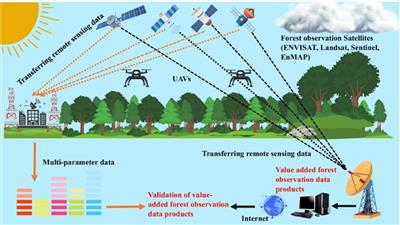
Amid the global challenges of forest degradation and climate change, the application of digital technology in forest resource management is increasingly recognized as an inevitable trend. The research by Do Cong Ba (Tan Trao University, Tuyen Quang province), published in the Proceedings of the 2nd National Scientific Conference on “Agricultural and Rural Environment and Sustainable Development,” focuses on analyzing the potential applications of artificial intelligence (AI) and remote sensing in forest monitoring. Agriculture & Environment Magazine is pleased to present this study to readers, providing an objective perspective on emerging approaches, from deforestation detection and wildfire prediction to supply chain transparency via blockchain, and exploring practical implementation prospects in Vietnam.
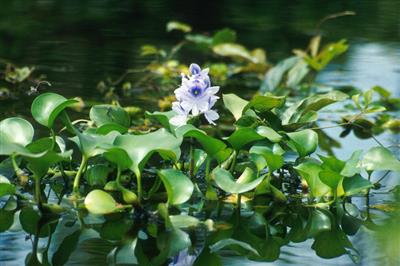
A research team at Nguyen Tat Thanh University has developed a method to convert water hyacinth, an invasive aquatic species, into activated carbon with the capacity to adsorb Tetracycline (TC)—a contaminant of emerging concern in aquatic environments. Experimental results showed that the activated carbon derived from water hyacinth exhibited a specific surface area of 630.46 m²·g⁻¹ and an adsorption capacity of 108.2 mg·g⁻¹, suggesting its applicability in wastewater treatment processes.
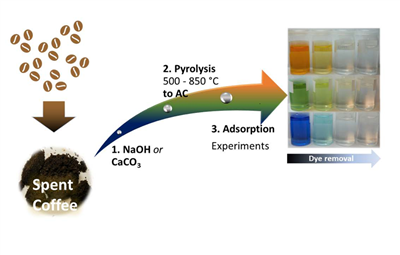
In the context of antibiotic residues in aquatic environments becoming a global concern, the search for effective, low-cost, and environmentally friendly treatment solutions is increasingly urgent. A Vietnamese research team from Nguyen Tat Thanh University, Ho Chi Minh City University of Natural Resources and Environment, the Institute of New Technology, and the Institute of Applied Research and Green Technology Transfer has introduced a novel approach: transforming spent coffee grounds into activated carbon with a high surface area, capable of removing up to 92% of tetracycline from water. The study not only addresses the challenge of antibiotic contamination but also illustrates the potential of circular economy practices in agricultural waste management.