



 Vietnamese officials, international organizations and experts have called for a structured and feasible roadmap to gradually reduce the dog and cat meat trade in Viet Nam, citing risks to public health, animal welfare and the need for a One Health approach, amid ongoing challenges in animal quarantine and rabies control.
On January 27, the Ministry of Agriculture and Environment convened the third Technical Meeting of the Companion Animals Working Group under the One Health Partnership (OHP) framework to coordinate implementation of the initiative “Roadmap toward reducing and ultimately eliminating the dog and cat meat trade in Vietnam”. The meeting gathered views on solutions to control rabies, strengthen companion animal management, ensure animal welfare and protect public health, in line with sustainable development orientations and prevailing regional and global trends.
Challenges in companion animal quarantine
Vu Tuan Anh, officer, Community Animal Husbandry and Veterinary Division, Department of Animal Health and Production

Regarding animal quarantine regulations, the Ministry of Agriculture and Environment requires strict quarantine for animals that are imported, exported or transported. Animals must be healthy, free from dangerous infectious diseases and meet quarantine requirements in accordance with standards of the World Organisation for Animal Health (WOAH) and Vietnamese law. They must also be accompanied by valid quarantine certificates issued by competent authorities of the exporting country or by Vietnamese authorities, as prescribed.
For the transport of animals into, out of and within the country, quarantine measures are required to prevent disease transmission and protect human health. Strict enforcement of animal quarantine regulations is a key foundation for effective disease prevention and control, ensuring animal health, food safety and public health.
Quarantine procedures are currently implemented at regional sub-departments of animal health and production in line with Vietnamese law and international agreements to which Vietnam is a party. For imported and exported animals, particularly dogs and cats, valid quarantine certificates are mandatory. Dogs and cats are also required to be vaccinated against rabies and to hold valid vaccination certificates. However, implementation faces significant challenges, especially for animals transported as personal luggage or accompanying passengers. Animals are often brought in outside administrative working hours, while quarantine personnel are limited and unable to maintain 24-hour coverage, placing considerable pressure on inspection and control efforts. In addition, routine management of imported and exported animals still carries risks if oversight is insufficient, highlighting the need to further strengthen coordination mechanisms and allocate additional resources.
For domestic transport, particularly of dogs and cats, inspection and supervision remain irregular and inconsistent. In practice, most movements of dogs and cats between localities are not accompanied by quarantine documentation. Many small-scale owners are unregistered and lack systematic herd management practices. Domestic quarantine is further complicated by low rabies vaccination coverage, limited capacity and experience at the grassroots veterinary level, and spontaneous, small-scale trading and transport along inter-provincial routes, making enforcement difficult. Public awareness of vaccination and quarantine obligations remains limited, with some people viewing them as non-mandatory, increasing the risk of disease transmission within the community.
Hanoi pilots phased transition away from dog and cat meat trade
Can Xuan Minh, Hanoi Sub-Department of Animal Husbandry, Fisheries and Veterinary Services
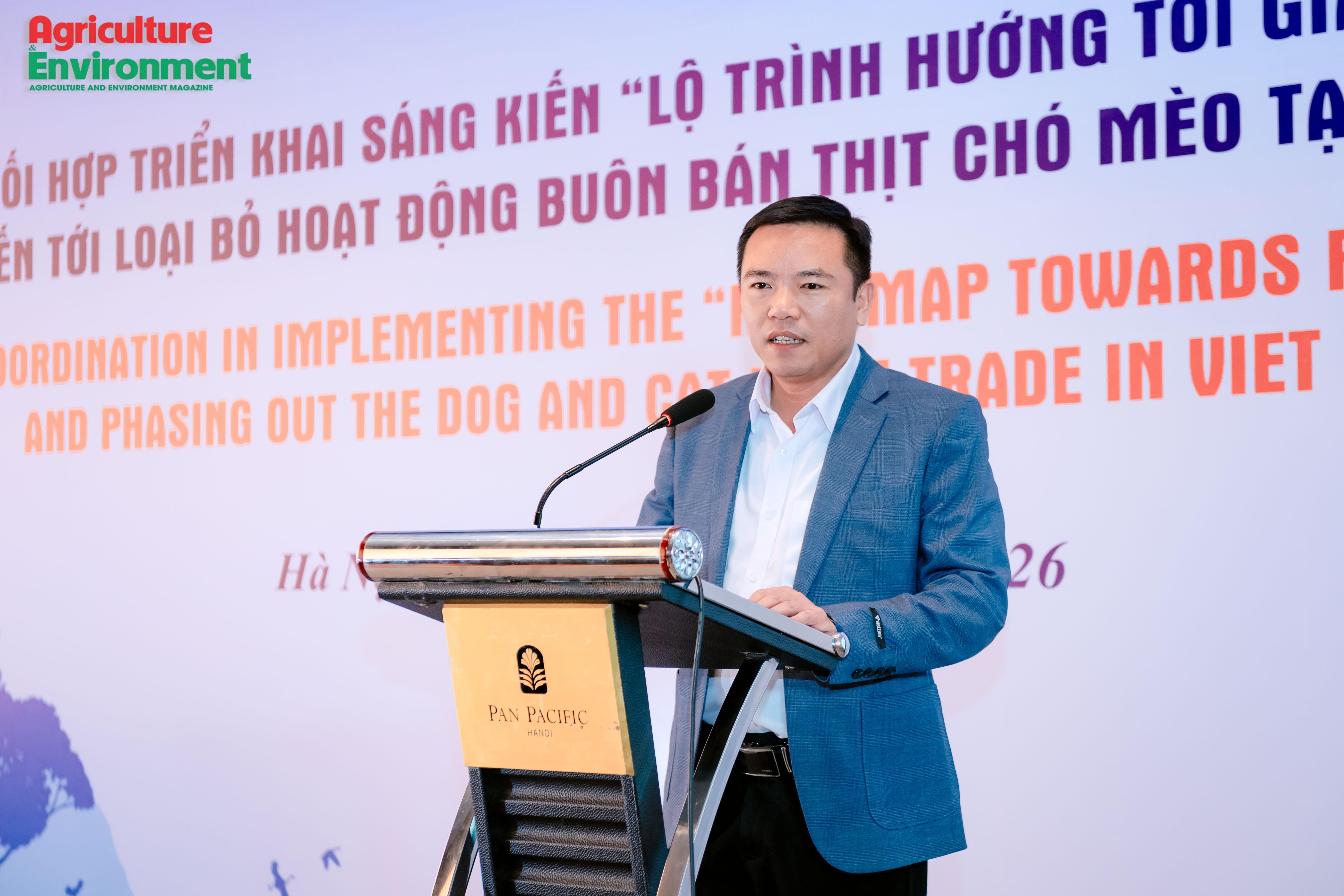
Thanks to close direction and timely budget allocation from the Hanoi People’s Committee, rabies has been effectively controlled in recent years, with a sharp decline in cases among both animals and humans. Since 2023, Hanoi has recorded no human rabies cases. However, available data show that rabies risks persist, requiring continued vigilance and coordinated prevention measures.
In the coming period, authorities will continue to implement key measures, including annual rabies vaccination campaigns for dogs and cats; the establishment and maintenance of disease-free zones; strengthened companion animal management; enhanced inter-agency coordination in disease surveillance, outbreak response and post-exposure prophylaxis for humans; and expanded public information and awareness campaigns.
A priority is the continued implementation of the project “Rabies prevention and sustainable economic development, with a phased transition of dog and cat meat trading in selected inner-city areas of Hanoi.” In 2025, surveys were completed at 113 dog and cat trading and slaughter establishments in 14 pilards, collecting data on operational practices, business attitudes, livelihood transition aspirations and market trends.
Based on these results, training courses were provided for 60 management officials and veterinary officers on disease control, legal regulations governing the trading, slaughter and transport of dogs and cats, and the prevention of rabies and other zoonotic diseases. Awareness-raising sessions were also held for 50 owners of dog and cat trading and slaughter facilities, focusing on food safety, disease risks and livelihood transition options. Communication activities included posters promoting the project and guidance for business owners interested in registering for future business model transitions.
Based on project outcomes, participants recommended that competent authorities promptly issue a unified legal framework governing the trading, transport and slaughter of dogs and cats.
This would provide a legal basis for local implementation, inspection and enforcement, while ensuring disease safety, food safety and animal welfare.
Roadmap proposed to phase out dog and cat meat trade in Viet Nam
Matt Backhouse, Head of Animal Care for Southeast Asia, FOUR PAWS International

Policy review, development and refinement will be critical in the coming period. Existing policies should be reviewed, strengthened and expanded to advance the reduction and eventual elimination of the dog and cat meat trade, in line with animal welfare objectives, public health protection and the One Health approach. At the same time, enforcement of existing regulations should be improved through stronger provisions on hygiene, food safety and animal transport management.
For pilot provinces and cities designated as dog- and cat-meat-free, selection should be based on clear criteria, prioritizing localities where such trade exists, where rabies risks are high and where there is strong commitment from local authorities. The model should focus on integrated measures to reduce the dog and cat meat trade, support enhanced disease surveillance and companion animal population management, and strengthen community awareness, rabies control and the prevention of illegal transport.
Public awareness should be identified as a central solution, aimed at changing behavior through the provision of clear and accurate information on risks associated with the dog and cat meat trade, relevant laws and policies, official information sources and reporting mechanisms for violations. Communication and education efforts should be implemented in an integrated manner, combining mass media, social media platforms and direct outreach to key groups such as local communities and students, to broaden reach and encourage behavioral change.
Maintaining nationwide reporting tools, developing communication materials, strengthening cooperation with the media, and regularly assessing public awareness and feedback to adjust communication approaches are also essential to ensure sustainable effectiveness.
Through coordinated communication, education and cooperation among stakeholders at both central and local levels, the dog and cat meat trade can be gradually reduced, while rabies-free zones are established and public health and animal welfare are protected.

Ensuring food security, adapting to climate change and delivering on sustainable development commitments have become increasingly interconnected policy priorities for Viet Nam. Against this backdrop, food systems transformation is emerging as a key pillar of the country's long-term development agenda.

In recent years, the One Health has become an increasingly important approach for addressing complex health challenges worldwide. The growing frequency of zoonotic disease outbreaks, rising antimicrobial resistance (AMR), food safety incidents, environmental pollution, and the impacts of climate change are gradually blurring the traditional boundaries between the health, agriculture, and environmental sectors.

As Viet Nam’s agricultural sector shifts from a production-driven model toward one centered on value creation, geographical indications (GIs) are emerging as an increasingly important tool for strengthening the competitiveness of local agricultural products. Beyond intellectual property protection, GIs are helping regions build distinctive identities, reorganize production along more professional lines and lay the groundwork for more sustainable agricultural development.

As green standards increasingly become mandatory requirements in global trade, green transition is no longer an option but a development imperative. In Quang Tri province, this transition is being advanced through science and technology, digital transformation, and low-carbon circular economy models. In this context, Agriculture and Environment Magazine interviewed Tran Quoc Tuan, Director of the Department of Agriculture and Environment of Quang Tri province.

China’s official market access approval for fresh Vietnamese pomelos and lemons has been widely regarded as a major opportunity for the fruit and vegetable sector following years of technical negotiations. However, at the conference on implementing the Protocol on phytosanitary requirements for these two commodities, held on May 14 in Ho Chi Minh City, representatives from regulatory agencies, enterprises, and local authorities emphasized that the greatest challenge now lies not in market access itself, but in the capacity to organize standardized production systems starting at the farm level.