



 With tens of thousands of products rated three stars or higher across the country, the “One Commune, One Product” (OCOP) program has increasingly affirmed its role in rural economic development since its inception. Beyond improving local incomes, OCOP has opened new directions for regional specialties, traditional craft villages, and community-based tourism. However, the program continues to face challenges related to production scale, quality standards, and international market access.
The Agriculture and Environment Magazine spoke with Dr. Nguyen Minh Tien, Director of the Trade Promotion centre for Agriculture (Agritrade), about OCOP’s major achievements, competitive advantages, obstacles, and the key solutions to ensure its sustainable growth in the years ahead.
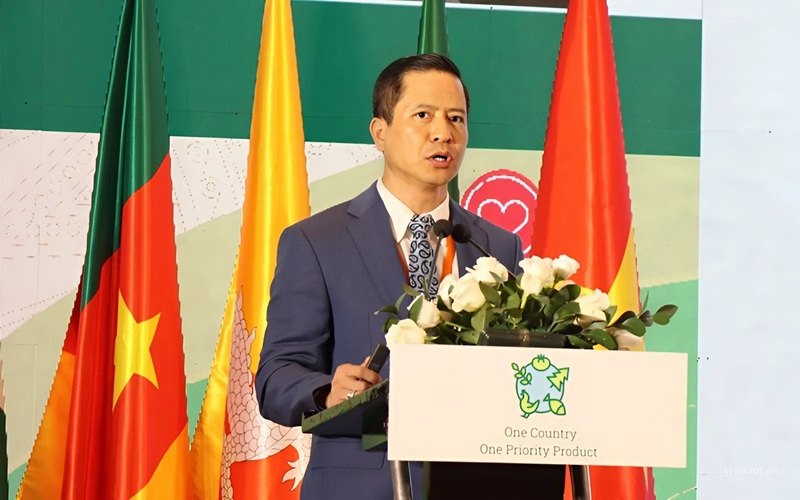
Dr. Nguyen Minh Tiến, Director of the Agritrade, delivered remarks at the Interregional high-level forum on the OCOP model held on July 15, 2025
Interviewer: After seven years of implementation, the OCOP program has made significant progress. How would you assess its most notable achievements so far?
Dr. Nguyen Minh Tien: Looking at nearly seven years of implementation, we can identify three key milestones of the OCOP program. First is the scale of implementation. All 63 provinces and cities nationwide have joined the program, with a total of 17,400 products certified with three stars or higher, including 126 five-star products. This is a major leap forward, showing that OCOP has truly spread nationwide and become a driving force for rural economic development.
Second is the diversity of participants. Currently, around 9,084 production entities are engaged in OCOP, comprising 32.9% cooperatives, 25.3% small enterprises, 33.5% production facilities and household businesses, and 8.3% cooperative groups. This composition reflects broad participation, from household-level production to enterprises, forming a vibrant ecosystem for OCOP products.
Third is the establishment of identity and cultural value. Through the three-to-five-star rating system, OCOP products have built consumer trust while gaining opportunities to enter supermarkets, trade centers, and export markets. Each product carries a story of its region, craft village, or community tourism activity, helping preserve and promote local identity. However, the proportion of five-star products remains relatively modest compared to the total, revealing a gap between diversity in scale and the need to enhance quality, an area that requires more effort in the coming phase.
Interviewer: In your view, what is the greatest competitive advantage of OCOP products, and how can that advantage be transformed into sustainable market value?
Dr. Nguyen Minh Tien: There are two core advantages. The first is local authenticity and uniqueness. Each OCOP product is rooted in local raw materials, indigenous knowledge, and cultural narratives, from regional specialties and craft village goods to community-based tourism services. These are difficult to replicate and thus create unique value in an increasingly competitive market.
The second advantage is standardization. OCOP products are evaluated and classified under the government’s three-to-five-star criteria based on multiple aspects such as quality, food safety, community value, production capacity, and commercial potential. This framework builds consumer trust and acts as a passport for products to enter supermarket systems, trade centers, and eventually export markets.
To convert these advantages into sustainable value, three simultaneous directions are needed. First, standardize and enhance production capacity, ensuring traceability and compliance with international standards such as HACCP, ISO, VietGAP, FDA, or Halal when applicable.
Second, build branding and communication strategies, packaging should reflect cultural identity and environmental friendliness, while product stories should be compellingly told through digital channels.
Third, establish production linkages across the value chain, enabling producers to fulfill large, consistent, and stable orders. This is the pathway for OCOP to maintain its local identity while expanding into broader markets.
Interviewer: How are OCOP products currently distributed? Which channels show the greatest potential?
Dr. Nguyen Minh Tien: OCOP products are now distributed through five main channels. First, traditional retail and supermarkets, including Saigon Co.op, Winmart, Hapro Mart, GO!, Aeon Mart, and OCOP points of sale in various provinces. Second, direct trade promotion, through fairs, exhibitions, and regular OCOP markets. Third, e-commerce and social media, via domestic platforms such as Shopee, Sendo, Voso, and Postmart, and international platforms like Alibaba, Amazon, and Rakuten; TikTok and Facebook are also widely utilized.
Fourth, tourism and gift channels, where many OCOP products are packaged as official gifts for ministries, localities, or diplomatic use, and are featured in craft villages, farmstays, and festivals. Fifth, export markets, with notable examples such as Le Gia fish sauce to Japan, Tai Hoan vermicelli and Bich Thao coffee to Europe, and ST25 rice to the United States. Vietnam has even hosted a national OCOP booth at the international fair in Milan, Italy.
Among these, e-commerce and social media are emerging as the fastest-growing channels, particularly because they reach younger consumers and transcend traditional geographic boundaries. However, to fully leverage them, OCOP producers must improve digital literacy and professionalize online store management. In the long run, exports and supermarket chains remain the most sustainable and large-scale channels, albeit with stricter requirements for standards, packaging, and supply capacity. Additionally, tourism and gifting hold great potential for brand building and experiential marketing, especially for culturally distinctive products.
Interviewer: What are the biggest challenges preventing OCOP from reaching premium segments and export markets?
Dr. Nguyen Minh Tien: The challenges can be grouped into six main categories. First, small and unstable production scale. Many OCOP entities are small household businesses, cooperatives, or manual producers, making it difficult to meet large orders or ensure consistency for modern distribution systems. Second, limited digital and e-commerce capabilities. Many producers lack dedicated online stores, skilled personnel, or the ability to leverage livestreaming and international e-commerce platforms, which limits access to younger and overseas consumers.
Third, standards and traceability. Some products lack certifications such as HACCP, ISO, VietGAP, FDA, Halal, or EU Organic. Many still do not have barcodes or QR codes for clear traceability. Fourth, packaging and product design remain simple and fail to convey cultural value or visual appeal, key factors for competitiveness in gifting and e-commerce markets.
Fifth, weak value-chain and regional linkages. Similar products from different provinces often overlap and compete rather than collaborate to build collective brands. Sixth, insufficient funding and policy support. Some localities lack strong resources for OCOP trade promotion, and brand registration remains fragmented. Combined with pressure from low-cost industrial goods and imports, OCOP products must undergo comprehensive upgrades to secure positions in premium and export markets.
Interviewer: Given these challenges, what key measures should be taken to promote trade and develop markets for OCOP products in the coming period?
Dr. Nguyen Minh Tien: Solutions must be implemented comprehensively at multiple levels. First, standardize and improve product quality. OCOP producers should receive training and support in production processes, food safety standards, eco-friendly packaging design, and traceability systems. This not only meets market demands but also enhances competitiveness.
Second, strengthen traditional trade promotion by supporting businesses and cooperatives to participate in domestic and international fairs and exhibitions. At the same time, build OCOP experience spaces at walking streets, cultural venues, and highway rest stops, where consumers can directly experience and purchase products. Another important direction is connecting OCOP with safe supply chains, particularly in schools, industrial parks, and collective kitchens, to expand the domestic market.
Third, develop OCOP gift packages and diplomatic channels, turning OCOP products into official gifts that promote both prestige and image. Most importantly, digital transformation must become a strategic priority, developing online stores, expanding livestream sales, joining international e-commerce platforms like Amazon and Alibaba, and launching digital marketing campaigns across TikTok, Facebook, and YouTube.
Finally, for these measures to be sustainable, we need financial mechanisms and regional linkages, including a dedicated budget for trade promotion, investment incentives for export-oriented OCOP products, and chain-based cooperation models to ensure stable supply. These are the key steps to elevate OCOP in the coming years.
Interviewer: Thank you very much for your time and insights!
Khanh Linh - Ngoc Huyen

International cooperation plays a crucial role in addressing the challenges of climate change and water resource management in the Mekong River Basin. This message was emphasized by Minister of Agriculture and Environment, Do Duc Duy, during his meeting with Ms. Busadee Santipitaks, CEO of the Mekong River Commission (MRC) Secretariat, on March 20.

Vietnam and Ireland are working to facilitate mutual market access for their agricultural products, particularly fruits, as part of broader efforts to enhance bilateral trade in the sector. This commitment was reaffirmed during a meeting between Vietnam’s Deputy Minister of Agriculture and Environment, Hoang Trung, and Ireland’s Minister of State at the Department of Agriculture, Food, Fisheries and the Marine, Noel Grealish, on March 13.

Vietnam is reaffirming its commitment to fostering a favorable investment environment for wind energy development, as highlighted during a recent meeting between Minister of Agriculture and Environment Do Duc Duy and Mr. Nate Franklin, Founder and CEO of Pacifico Energy, a leading U.S. renewable energy corporation.

On March 12, in Hanoi, Deputy Minister of Agriculture and Environment Tran Quy Kien hosted a working session with the Secretariat of the China-ASEAN Mining Cooperation Conference, led by Secretary-General Li Xiudan. The meeting underscored the commitment of both nations to deepening their collaboration in mineral exploration and mining technology, with a focus on sustainability and environmental protection.

On March 12, Minister of Agriculture and Environment Do Duc Duy held talks with Mr. Tsutomu Takebe, a member of the Board of Trustees of Vietnam - Japan University and former Minister of Agriculture, Forestry, and Fisheries of Japan. The meeting focused on strengthening bilateral cooperation in developing high-quality human resources for Vietnam’s agricultural sector, with Japan serving as a key partner in training, technology transfer, and business management in agriculture.