




 In the context of accelerating climate change, sea-level rise, and increasingly severe coastal erosion in the Mekong Delta, field-based scientific evidence on the coastal protection functions of mangrove forests (MF) has become critically important for shoreline planning and management. Recently, a research team comprising Ly Trung Nguyen, Danh Tinh, and Le Thanh Khang from the College of the Environment and Natural Resources, Can Tho University, completed a large-scale field study in coastal mangrove forests located in the former Soc Trang province, now administratively part of Can Tho city.
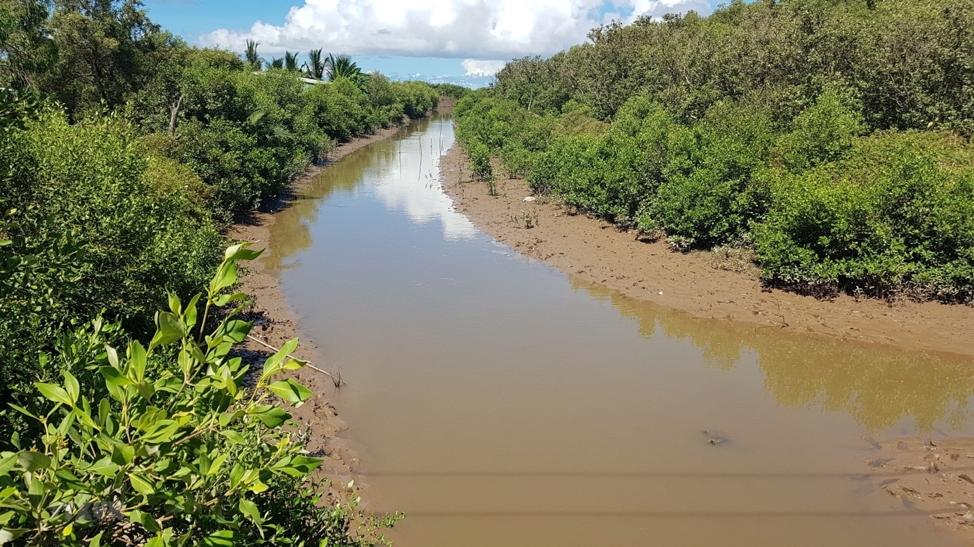
The study provides clear quantitative evidence, for the first time, through simultaneous field measurements of wave attenuation and sediment deposition under two contrasting ecological conditions of mangrove forests: the forest edge and a location 50 m inside the forest. The results offer robust experimental data on the relationship between mangrove forest structure and its ecological functions, contributing directly to coastal protection planning in the Mekong Delta.
Research background and scientific rationale
Mangrove forests are intertidal ecosystems located at the interface between land and sea, functioning as natural buffer zones that absorb wave energy, reduce coastal erosion, and stabilize shorelines. Numerous international studies have demonstrated that mangroves attenuate wave dynamics, trap suspended sediments, and promote natural accretion processes. However, in Vietnam—particularly in the coastal areas of Soc Trang and Can Tho—field-based studies supported by detailed instrumental measurements remain limited.
The Mekong Delta is currently facing multiple challenges, including widespread shoreline erosion, land subsidence, sea-level rise, altered hydrological regimes driven by climate change, and upstream anthropogenic impacts. In this context, mangrove forests, characterized by low maintenance costs, high ecological value, and strong natural regeneration capacity, are increasingly regarded as a more effective solution than hard-engineering structures such as seawalls and coastal dikes. Nevertheless, coastal managers and policymakers require reliable experimental data to support decisions on mangrove conservation, restoration, and coastal zone planning. This scientific gap underscores the necessity and practical relevance of the present study.
Methodology: Integrated field measurements of waves, sediment deposition, and mangrove forest structure
study area
The study was conducted in the coastal zone of the former Soc Trang province, now within the administrative boundaries of Can Tho City. This area contains the largest stands of Sonneratia caseolaris in Viet Nam. Between 2016 and 2022, mangrove forest area showed an increasing trend, contributing to improved coastal protection capacity, although the region continues to experience strong erosion pressures and sediment dynamics.
Experimental design: Two monitoring locations were established:
M1 – Forest edge: characterized by lower tree density, with larger average tree height and trunk diameter.
M2 – Inside the forest (50 m from the forest edge): characterized by significantly higher tree and root density.
At each location, the following measurements were conducted:
- Mangrove forest structure survey: Mangrove structure was surveyed within standard plots (SP) of 100 m² (10 × 10 m) using manual measurement methods. Parameters included tree height, trunk diameter, basal diameter, tree density, and root density. Trunk diameter was measured at 1.3 m above ground (DBH) using a measuring tape. Root height and root abundance were recorded within 1 m² subplots, with measurements repeated three times for each SP. Ground elevation was determined manually using the water tube leveling method.
- Wave measurements: Pressure sensors were installed to continuously record wave characteristics over semi-diurnal tidal cycles typical of the East Sea.
- Sediment deposition sampling: Sediment collectors made of PVC tubes (9 cm in diameter) were installed in a 360-degree configuration and fixed in place for 24 hours to collect deposited sediment.
Laboratory analysis:
Sediment samples were oven-dried at 105°C for 24 hours to determine sediment mass.
The simultaneous measurement of wave dynamics, sediment deposition, and mangrove forest structure produced an integrated and reliable dataset reflecting the functional relationship between MF structure and coastal protection processes.
Wave attenuation within mangrove forests
Results from the two monitoring sites revealed pronounced differences in wave energy. At the location inside the forest (M2), wave energy was consistently lower than at the forest edge (M1). Wave energy decreased by 19–39%, depending on water depth conditions (shallow, intermediate, and deep). Linear regression analyses yielded slopes consistently lower than one, confirming progressive wave attenuation as waves propagated through the mangrove forest structure.
Although trees at the forest edge exhibited larger average trunk diameters (25.57 cm compared to 8.5 cm), tree density inside the forest was three times higher (9 trees per SP compared to 3 trees per SP). This finding demonstrates that vegetation density plays a more critical role than individual tree size in wave attenuation.
Root density was also higher at M2 (52 roots/m² compared to 41 roots/m²), forming a dense below-ground structure that strongly obstructed flow and enhanced wave energy dissipation within the forest.
Sediment deposition enhanced inside dense mangrove forests
Sediment deposition serves as a key indicator of mangrove ecosystem performance in maintaining and expanding intertidal flats. The results showed that:
- At the forest edge, average sediment deposition reached 29.05 g per 24 hours.
- At 50 m inside the forest, sediment deposition increased to 39.53 g per 24 hours, representing a 36.07% increase compared to the forest edge.
Directional analysis further indicated that sediment distribution varied with orientation. At the forest edge, the northwest direction exhibited the highest sediment accumulation, while inside the forest, the southeast direction dominated. This pattern corresponds with established sediment transport dynamics along the Soc Trang–Can Tho coastline, where sediment movement predominantly follows a northwest–southeast trajectory. These results indicate that mangrove forests not only retain sediment but also regulate its spatial distribution along the coast.
Relationship between wave attenuation and sediment deposition
Correlation analysis demonstrated a strong relationship between wave attenuation and sediment deposition: greater reductions in wave energy were associated with higher sediment accumulation. This finding aligns with sediment dynamics theory, whereby reduced wave energy leads to lower flow velocities, facilitating the transition of suspended particles from transport to deposition.
At the forest edge, low tree density resulted in limited wave attenuation and higher flow velocities, constraining sediment deposition. In contrast, inside the forest, high tree and root density reduced wave energy by 19–39%, created calmer hydrodynamic conditions, and enhanced sediment deposition. Through this mechanism, mangrove forests function as natural sediment traps, continuously reinforcing the substrate and contributing to long-term coastal stability.
Scientific and practical implications
The study provides several important contributions to mangrove conservation and coastal management in Vietnam: It offers rare quantitative field-based evidence of wave attenuation by mangrove forests in the Mekong Delta.
It supplies scientific parameters to support the design of coastal protection mangrove belts, including optimal forest width, species selection, and planting density.
It reinforces the role of mangrove expansion as an effective form of green infrastructure, outperforming hard-engineering solutions in terms of sustainability, resilience, and ecological co-benefits.
It establishes a foundation for further research on sediment dynamics, nearshore currents, and the resilience of degraded mangrove systems.
Mangrove forests as a sustainable ecological solution for the Mekong Delta
Based on field measurements, the study concludes that mangrove forests reduce wave energy by 19–39% over a 50 m forest transect and increase sediment deposition by 36.07% compared to forest edge conditions. Mangrove forest structure—particularly tree and root density—shows a strong positive relationship with wave attenuation and sediment retention capacity. As such, mangrove forests play a critical role in erosion reduction, shoreline stabilization, and climate change adaptation in the Mekong Delta.
These findings provide strong scientific support for prioritizing mangrove conservation and restoration as a core strategy for coastal safety and sustainable development. Future research should adopt interdisciplinary approaches integrating marine dynamics, climate processes, geomorphology, and biodiversity to develop predictive models and integrated coastal management solutions, enabling local authorities to respond more effectively to climate change challenges.
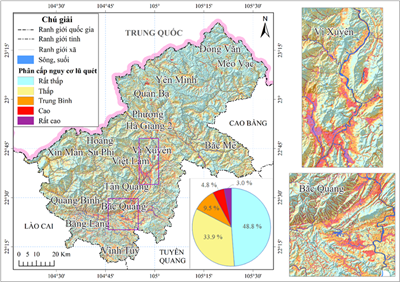
Following the data-building and field-validation groundwork outlined in Part 1, this second installment, led by Le Nhu Nga and colleagues at the Institute of Mechanics, Vietnam Academy of Science and Technology, examines how three machine-learning models were tested against the complexities of Vietnam’s mountainous terrain. Each algorithm offered a different path to decoding the nonlinear interactions that drive flash-flood formation—yet the performance gap between them also reflected the physical realities of steep slopes, fractured bedrock, and highly variable extreme rainfall.
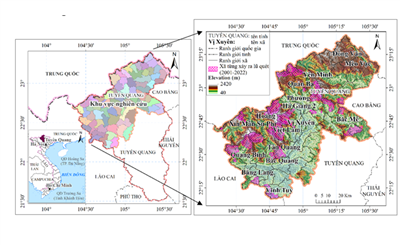
Flash floods in Vietnam’s northern mountains are not only tallied in annual disaster statistics, they shape the land, livelihoods, and planning decisions across entire districts. As climate change intensifies extreme rainfall, the demand for reliable and accessible hazard maps becomes urgent. A research team from the Institute of Mechanics, Vietnam Academy of Science and Technology (VAST) has demonstrated that Geospatial Artificial Intelligence (GeoAI) can meet this demand, producing high-precision, data-driven maps of flash flood risk for the northern communes of Tuyen Quang province, an area once part of Ha Giang’s rugged highlands.

From familiar plants such as okra, jute, Malabar spinach, and aloe vera, a research team from Kien Giang University has explored a new pathway to improve the treatment of domestic wastewater—one of the major pollution sources, accounting for more than 30% of all wastewater generated today. The study found that okra extract, a natural and readily available plant-based coagulant substance, achieved a chemical oxygen demand (COD) removal efficiency of 64.18%, reduced turbidity by more than 89%, and significantly enhanced nitrogen and phosphorus removal when combined with PAC. These findings suggest strong potential for using plant-derived coagulant substances in small-scale household and community wastewater treatment models.

As Vietnam advances toward digital government and modern natural resource management, the land sector has emerged as a pioneering field requiring institutional, technological, and data governance reforms. A research group from the Department of Land Management under the Ministry of Agriculture and Environment, including experts Nguyen Khac The, Dinh Hong Phong, and Tran Van Tien, has conducted the study “Legal basis and requirements for institutional improvement in the implementation of electronic certificates of land use rights and ownership of assets attached to land.”
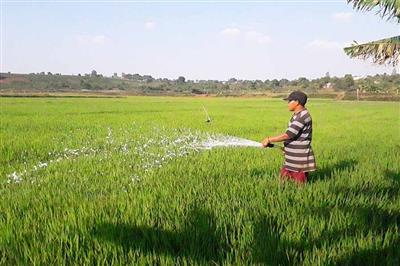
Traditional flooded rice cultivation in Vietnam ensures stable yields but consumes tens of billions of cubic meters of water and emits tens of millions of tons of methane (CH₄) annually. As Vietnam commits to achieving net-zero emissions by 2050, the research and application of the Alternate Wetting and Drying (AWD) irrigation technique have opened a new pathway, reducing irrigation water use by 20-50% and cutting greenhouse gas emissions by nearly half.